If your furnace isn't heating — or it's running but the air never gets warm — you're in one of the more stressful breakdowns a Bay Area homeowner hits, because no-heat in a cold snap feels urgent and every company gets the same call at the same time. The good news is that 'runs but doesn't heat' points to a specific, diagnosable set of causes, and several of them you can rule out yourself before you call for furnace repair in Santa Clara. Here's what's most likely wrong, what to check safely, and the signals that tell you whether it's a repair or a replacement.
Why Your Furnace Isn't Heating — The Usual Causes
When the blower runs but the air is cold, or the furnace won't fire at all, the breakdown is in the ignition or heat-delivery chain. These are the causes, roughly in order of how often we see them:
- Dirty or failed flame sensor — the #1 cause. The flame sensor confirms the burner lit; if it's coated in carbon or worn, the furnace lights and immediately shuts the gas off as a safety measure. You hear it click and try repeatedly.
- Bad igniter — the igniter that lights the burner cracks or burns out; the furnace never fires. Common on furnaces 8+ years old.
- Blower motor or capacitor — the motor that pushes air through the house fails, or its capacitor weakens; you may hear humming but feel little or no airflow.
- Pilot or gas valve issue — on older furnaces, the pilot won't stay lit or the gas valve won't open; the furnace tries to start and fails.
- Cracked heat exchanger — the most serious. A crack lets combustion gases, including carbon monoxide, into the air stream. This is a safety-driven replacement, not a repair.
- Thermostat or control board — the thermostat isn't calling for heat, or the control board isn't sending the signal; the furnace sits dead even though nothing is mechanically wrong.
- Dirty filter or blocked airflow — a clogged filter can trip the limit switch and shut the burner down to prevent overheating; the blower runs but no heat comes out.
What You Can Safely Check First
Before you call, rule out the cheap and easy causes — one of these might get you heat again tonight:
- 1Check the thermostat. Confirm it's set to heat and above room temperature, and the batteries aren't dead; a blank or stuck thermostat is a common no-heat cause.
- 2Check the air filter. A clogged filter can shut the burner down via the limit switch; replace it if it's dirty and see if heat returns.
- 3Check the breakers and the furnace switch. Make sure the breaker and the wall switch near the furnace are both on; a tripped breaker kills everything.
- 4Check the gas valve. Confirm the gas valve on the gas line is open (handle parallel to the pipe); if it got bumped closed, the furnace can't fire.
- 5Smell for gas. If you smell gas, don't try to fix anything — leave the house, don't flip switches, and call the gas company or 911. This is the one check that means stop and call, not DIY.
When It's a Cracked Heat Exchanger
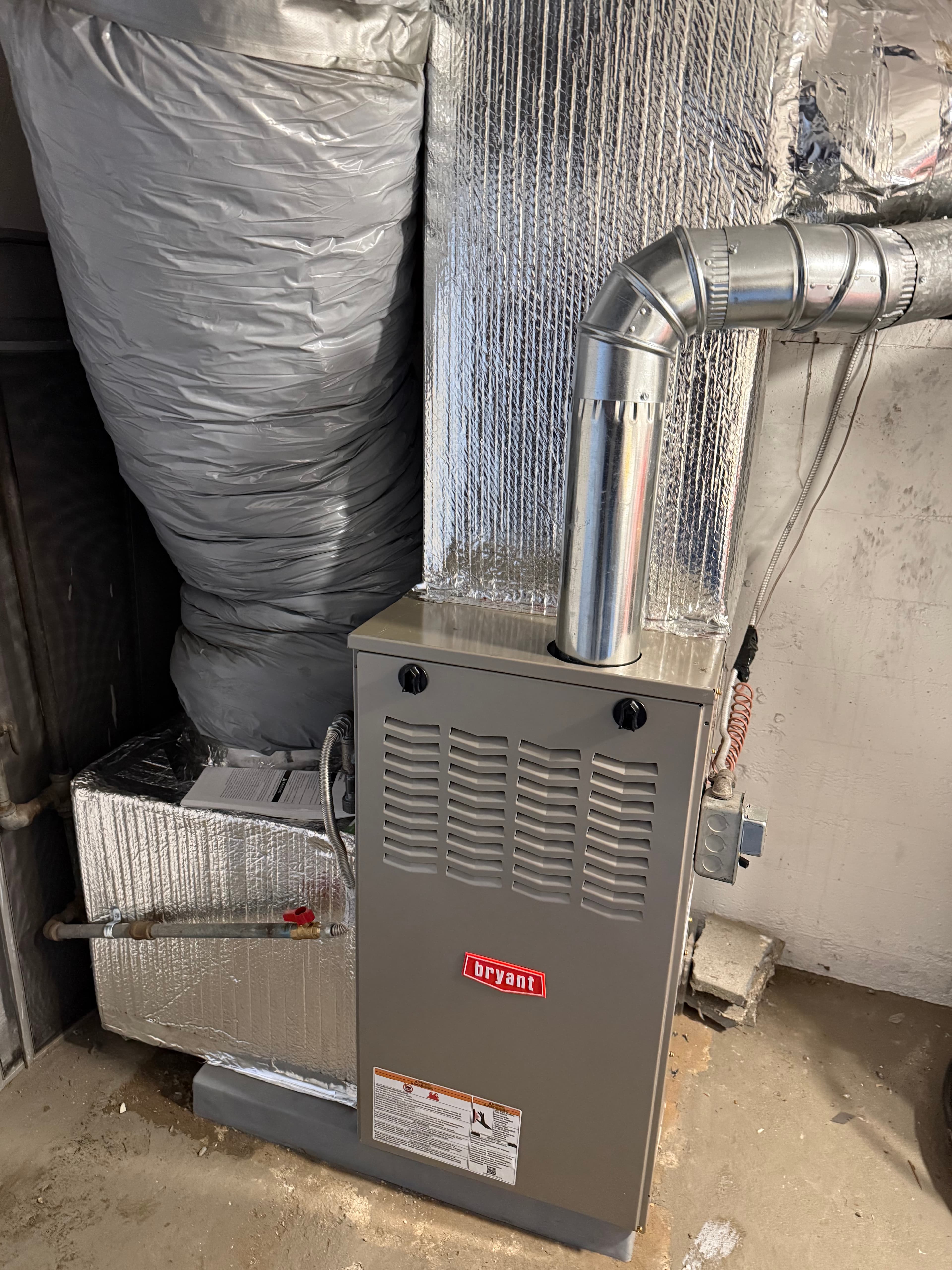
A cracked heat exchanger is the one furnace problem that changes the whole conversation. The heat exchanger separates the combustion gases from the air you breathe; when it cracks, carbon monoxide and other exhaust can mix into your home's air. A good technician finds it during a repair or maintenance visit, and the correct response is to shut the furnace down and replace it — not patch it. If your carbon monoxide detector has gone off, or the technician shows you a crack (ask to see it on a camera), treat it as a safety replacement. This is also where the repair or replace decision gets made for you: a cracked heat exchanger on an older furnace is almost always a replacement, because the part and the labor approach the cost of a new furnace installation — and you get a new warranty and a correctly sized system instead of fixing the most failure-prone component on an aging unit.
Repair vs Replace: The Signals That Actually Matter
Most furnace breakdowns are repairs — a flame sensor, an igniter, a capacitor. The question is when a repair stops making sense. The signals that actually matter are the unit's age, how often it's breaking down, whether the heat exchanger is compromised, and the repair cost relative to the life left. A useful gut-check is the $5,000 rule: multiply the repair cost by the unit's age in years, and if the result is over $5,000, lean toward replacing. A $400 igniter on a 4-year-old furnace is an easy repair; a $600 repair on a 15-year-old furnace gives $9,000, which points to replacement — especially if it's the second or third repair this season. Older furnaces and R-22-era systems are also approaching the point where parts get scarce and the efficiency gains from a new unit pay back the difference. When it's time, a proper Manual J load calculation sizes the replacement to your house rather than a guess, which matters more in Santa Clara's mix of mid-century and newer homes than people assume.
Cause, Symptom, and Whether It's a DIY Check
| Cause | Typical symptom | DIY or pro | Relative cost |
|---|---|---|---|
| Dirty flame sensor | Lights then shuts off, repeated clicking | Pro (clean/replace) | $ |
| Bad igniter | Never fires, no flame | Pro | $ |
| Clogged air filter | Blower runs, little heat, trips off | DIY (replace filter) | $ |
| Tripped breaker / switch | Completely dead | DIY (reset once) | $ |
| Blower motor / capacitor | Humming, weak or no airflow | Pro | $$ |
| Gas valve / pilot (older) | Pilot won't stay lit | Pro | $$ |
| Cracked heat exchanger | CO alarm, soot, replace not repair | Pro — safety replacement | $$$$ |
| Control board / thermostat | Furnace won't start, nothing mechanical wrong | Pro | $$ |
The Santa Clara Angle
A lot of Santa Clara housing stock is mid-century, and many homes are running furnaces installed 15-20 years ago — right in the window where igniters, flame sensors, and heat exchangers start to fail. The mild Bay Area climate means furnaces rack up fewer hours than in colder regions, which can extend their life, but it also means an aging unit can fail slowly and quietly during a cold snap rather than give clear warning. The fix isn't always a bigger furnace; a replacement sized with a real Manual J to the actual house often heats more evenly at a lower capacity than an oversized one that short-cycles. A regular preventive maintenance visit — and an HVAC repair check before winter that cleans the flame sensor and inspects the heat exchanger — catches the safety-critical stuff before a no-heat call at the worst possible time.
The Bottom Line
A furnace that runs but doesn't heat is usually a dirty flame sensor, a bad igniter, or an airflow problem — and a dead thermostat or tripped breaker are the cheap things you can rule out yourself first. If the basics check out and there's still no heat, get a technician out before a small igniter or sensor issue sits long enough to mask a cracked heat exchanger, which is a safety replacement, not a repair.
Furnace not heating in Santa Clara? We'll diagnose it honestly — fix the real cause, not the most expensive one. Call (408) 300-8254 for same-day furnace repair across Santa Clara, San Jose, and the Bay Area. No obligation.